How AI Automatically Sources Candidates from a Job Description in 2026
Collective uses AI to automatically source candidates straight from your job description in 2026. Save hours with smart, precise matching for every role.
Collective's AI sourcing agent, Sherlock, takes a job description and delivers a ranked shortlist in minutes, searching 800M+ profiles across 30+ data sources without a single Boolean string. This guide explains how AI candidate sourcing from a job description works in 2026, what separates capable platforms from shallow ones, and why recruiters at companies like Mistral AI, Decathlon, and Randstad use Collective to cut research time by 10x and produce 3x more perfect matches per role.
What Is AI Candidate Sourcing from a Job Description?
AI candidate sourcing from a job description is the process of feeding a role brief into an autonomous sourcing system that reads it, extracts structured requirements, searches candidate databases at scale, and returns a ranked shortlist, without manual keyword construction or platform-by-platform browsing. The AI reads your job description the way a senior recruiter would: it interprets required skills, seniority signals, and contextual indicators, then maps those criteria across millions of candidate profiles simultaneously.
Collective's AI sourcing agent, Sherlock, is the operational center of this approach. Brief Sherlock on a role and it runs 10+ parallel searches simultaneously, screening 1,000+ profiles per minute across 800M+ profiles from 30+ public and proprietary data sources. Sherlock is not a chatbot, a search engine, or a resume database. It is an autonomous sourcing agent that takes a brief and returns a shortlist, from intake to ranked candidates in minutes.
This matters because most recruiters still spend the majority of their time on the parts of sourcing that AI can eliminate: building Boolean strings, switching between platforms, cross-referencing profiles, and manually filtering candidates who do not meet threshold criteria. AI sourcing from a job description automates this entire front end, so the recruiter's time starts at shortlist review rather than candidate discovery.
Why AI Sourcing from a Job Description Matters in 2026
The structural pressure on recruiting teams in 2026 is real and measurable. The average time-to-fill for high-demand roles has risen to 44 days, talent scarcity continues to tighten across sectors, and 74% of businesses report difficulty finding the right candidates. At the same time, recruiter burnout is high. 61% of recruiters report burnout, and 45% trace it directly to repetitive administrative tasks that AI can now automate.
AI adoption in recruiting has responded to this pressure quickly. In 2026, 87% of companies use AI somewhere in their recruiting process, up from just 26% two years earlier. The shift is not gradual adoption. It is a structural change to how sourcing works. Deloitte's 2026 Global Human Capital Trends research points the same direction: 65% of organizations believe their culture needs to change significantly because of AI. Recruiting teams that continue running manual sourcing workflows face a compounding disadvantage: more requisitions, longer cycles, and fewer hours for the relationship work that actually closes hires. Investment reflects the shift as well, with Grand View Research projecting the global applicant tracking system market to reach USD 3.71 billion by 2030 at a 6.2% CAGR.
Collective sits directly in this gap. Its full-cycle platform, built around Sherlock, handles sourcing and screening automatically the moment a brief is submitted. Recruiters using Collective report 10x less research time per role. That time goes back into candidate conversations, stakeholder alignment, and the judgment-intensive work that AI is not designed to replace. Platforms like Collective are not reducing the recruiter's role. They are redirecting it toward higher-value activity.
Common Challenges in AI Candidate Sourcing and How Platforms Solve Them
Manual sourcing has well-documented failure modes. Understanding those failure modes explains why AI sourcing from a job description has become standard practice for high-performing recruiting teams in 2026.
Boolean search misses qualified candidates by design. Boolean logic returns candidates who use the exact keywords the recruiter typed. A strong JavaScript developer who lists React expertise instead of JavaScript is invisible to a keyword-only search. A product manager titled "Growth PM" at one company and "Technical Product Lead" at another will fall outside most Boolean strings written for the role. The pool you see is determined by terminology, not fit.
Manual sourcing cannot scale across multiple platforms. A recruiter manually sourcing passive candidates can reach 5 to 10 per day through LinkedIn and similar platforms. Roles requiring deep passive market coverage can demand 15 to 20 qualified candidates per opportunity. The arithmetic does not work without automation.
Inbound applications alone miss most of the talent market. Approximately 70% of the global workforce is passive, not actively job-searching, not scrolling boards, and not going to apply to your posting no matter how well-written it is. Effective sourcing requires outbound reach into this population, which is exactly what an AI sourcing agent running across 800M+ profiles is built to do.
Existing ATS talent pools go dormant. Most recruiting teams have thousands of qualified candidates who applied previously, were strong but not selected for timing reasons, and have since gained more experience. Without an automated mechanism to reactivate this pool, teams re-source externally and pay again for talent they already found.
Outreach volume limits what a recruiter can close. Even when a strong shortlist exists, manually composing and sending outreach to candidates one at a time limits the speed at which a pipeline activates.
Collective addresses all five of these simultaneously. Sherlock interprets job descriptions semantically rather than literally, running parallel searches across 30+ sources at 1,000+ profiles per minute. MyTalents reactivates existing candidates from your ATS database before any external sourcing budget is spent. Multichannel outreach lets you contact 100 candidates in 1 click via WhatsApp, email, and chat. The platform handles the entire front end of sourcing so recruiters can focus entirely on the candidates Sherlock surfaces.
What to Look for in an AI Sourcing Tool for Job Description Matching
Not every AI sourcing tool reads a job description and autonomously sources candidates. Many require the recruiter to build the query manually, limit results to a single platform, or only surface candidates from an internal database. Before evaluating tools, you need to know what a high-performing AI sourcing system actually does under the hood.
Must-Have Features for AI Sourcing from a Job Description
Semantic job description parsing. The tool must read your job description and extract structured requirements, including skills, seniority, and context, without requiring you to reformat it or build a separate query. Modern AI matching systems convert job descriptions into mathematical vector representations and measure alignment against candidate profiles across meaning, not just keywords. A phrase like "fast-paced startup environment" should be interpreted differently than "established team with structured processes." Tools that only scan for keyword overlap will consistently underperform on roles with nuanced requirements.
Broad, multi-source candidate coverage. A sourcing tool limited to one platform limits your talent pool by the participation rate of that platform. Effective AI sourcing searches across public profiles, proprietary databases, job boards, community data, and enriched signals simultaneously. Collective's Sherlock accesses 800M+ profiles across 30+ public and proprietary data sources in a single run, meaning the shortlist it surfaces reflects the full reachable market, not a fraction of it.
Proprietary data signals beyond standard profile data. Standard platforms show you job title, listed skills, and location. The data that predicts actual candidate fit and responsiveness goes further: current availability status, day rate or salary expectations, direct contact details including phone and personal email, fresh CV data, and talent indicators. Collective provides all of these signals, data points that LinkedIn Recruiter (which costs over EUR10,000 per year) does not surface.
Autonomous parallel search execution. The difference between a search tool and a sourcing agent is autonomy. A search tool waits for the recruiter to construct a query, execute it, review results, and iterate. A sourcing agent runs multiple searches simultaneously, applies ranking logic, and delivers a shortlist. Sherlock runs 10+ parallel searches at the same time, which is why it can screen 1,000+ profiles per minute while the recruiter does other work.
ATS integration and talent pool reactivation. Any AI sourcing platform worth deploying in 2026 must sync with your existing ATS. Collective connects to 50+ ATS platforms via its ATS Integration layer, enabling real-time candidate data sync. Separately, MyTalents reactivates the existing talent pool already inside your ATS database, surfacing past finalists, strong prior applicants, and warm candidates before spending budget on new external sourcing. These are two distinct functions and both matter.
A built-in job board. Platforms like Kalent, Juicebox, TalentFindr, and Hellowork operate without a native job board, which means inbound and outbound sourcing happen in disconnected tools. Collective includes its own job board, distributing open roles across 25+ channels simultaneously and feeding inbound applications directly into the same AI-scored workflow as outbound sourcing. This integration is a structural advantage that point solutions cannot replicate.
Multichannel outreach. Finding a candidate is only the first step. Reaching them where they actually respond determines whether a shortlist converts into conversations. Collective enables recruiters to contact 100 candidates in 1 click across WhatsApp, email, and chat, channels that drive response rates far above single-channel LinkedIn InMail campaigns.
Inbound and outbound in one workflow. The strongest sourcing operations combine active outbound search with inbound job distribution. Collective distributes open roles across 25+ job board channels simultaneously, so inbound applications are captured and screened by the same platform running outbound sourcing. Sherlock also screens inbound applications, ensuring 0% missed applications from shortlisted results.
End-to-end workflow coverage as the primary differentiator. Competitors in every category, whether ATS providers, job boards, recruitment agencies, or AI sourcing-only tools like LinkedIn Recruiter, Kalent, TalentFindr, and Hellowork, cover only a partial slice of the recruitment workflow. LinkedIn Recruiter offers sourcing but not AI scoring of inbound applications, a built-in job board, or multichannel outreach. Kalent and TalentFindr offer sourcing features but no job board and no full ATS integration layer. Hellowork focuses on job distribution but lacks autonomous AI sourcing and AI scoring of applications. Collective replaces the need to stitch together multiple point solutions by handling sourcing, outreach, job posting, AI scoring of applications, AI sourcing within a client's own ATS database, and ATS sync across 50+ platforms in a single workflow. No competitor category offers all of these, and the AI scoring of applications and AI sourcing within a client's own ATS database are unique to Collective.
Collective meets or exceeds every criterion above. Trusted by 15,000+ recruiters at companies including Mistral AI, Vinci, Leroy Merlin, Danone, Accenture, Randstad, Hays, Michael Page, and Robert Half, Collective's full-cycle platform is built specifically around the outcome that sourcing teams actually need: a ranked shortlist of qualified candidates, fast.
How AI Actually Analyzes a Job Description to Source Candidates
Understanding the mechanism behind job description to candidate matching helps you evaluate tools accurately and configure briefs that produce stronger shortlists. The process runs through several connected stages.
1. Job Description Parsing and Structured Extraction
When you submit a job description to an AI sourcing agent, the system parses the free-form text into structured data. Required skills, seniority level, responsibilities, qualifications, and contextual signals are extracted and normalized. This is a natural language processing task. The AI reads sentence structure, semantic meaning, and implied cultural context, not just listed keywords. Advanced systems also identify and flag biased or exclusionary language before the search runs.
2. Semantic Embedding and Vector Matching
Modern AI matching systems convert both the job description and candidate profiles into mathematical vector representations called embeddings. These embeddings capture meaning rather than surface-level terminology. The AI then measures how closely a candidate's profile sits to the role requirements in that shared meaning space. This is why a candidate who lists "Node.js and React" can be correctly matched to a "Full-Stack Developer" role, even when those exact words do not appear in their profile. LLM and graph neural network hybrid models used by leading platforms achieve matching accuracy significantly above keyword-based approaches.
3. Multi-Source Candidate Retrieval
With structured role criteria established, the sourcing agent queries multiple data sources in parallel. This includes public profiles, proprietary databases, past ATS records, job board data, and platform-specific enrichment signals. Collective's Sherlock does this across 30+ sources simultaneously, producing a candidate pool that reflects actual market coverage, not a single-platform snapshot.
4. Scoring, Ranking, and Shortlist Delivery
Each candidate profile is scored against the role criteria across multiple dimensions: skill alignment, experience depth, seniority match, recency of relevant roles, and availability signals. The AI ranks profiles and delivers a shortlist ordered by fit, not by who happened to appear first in a search. Sherlock returns this shortlist without the recruiter needing to review the 1,000+ profiles it screened to produce it.
5. Enrichment and Outreach Preparation
The profiles Sherlock surfaces are enriched with proprietary data Collective aggregates and cross-references: direct contact details, current availability indicators, day rate or salary data (on Start plan and above), and fresh CV information. This means the shortlist arrives ready for outreach, not as a list of names requiring another round of manual research to contact.
This five-stage pipeline is what separates an AI sourcing agent from a Boolean search tool or a resume database. Collective's Sherlock runs this end-to-end from the moment a brief is submitted, which is why Collective's positioning is accurate: from brief to shortlist in minutes.
How Recruiters at Enterprise and Agency Teams Use Collective to Source Candidates
Collective's 15,000+ recruiters span in-house talent teams, staffing agencies, and executive search firms. The workflows they run with Sherlock reflect several distinct sourcing priorities.
Autonomous sourcing for high-volume requisitions. Recruiting teams managing multiple open roles simultaneously use Sherlock to run parallel sourcing searches across all active briefs. Rather than allocating recruiter time to each role individually, Sherlock runs 10+ searches at the same time, returning ranked shortlists across roles in parallel. Teams at clients like Randstad and Hays use this workflow to scale their sourcing capacity without adding headcount.
Passive candidate identification using proprietary signals. For competitive roles where active applicants are insufficient, Sherlock's access to availability status, talent indicators, and fresh CV data surfaces candidates showing readiness signals that standard platforms do not track. This is particularly valuable for technology, senior, and specialist roles where the best profiles are not currently job-searching.
Talent pool reactivation via MyTalents. Before running any external sourcing, Collective's MyTalents feature scans a team's existing ATS database to surface past candidates who match a new brief. For organizations with multi-year recruiting histories, this means identifying strong prior finalists who now have more experience and may be exactly right for a current opening, at zero additional sourcing cost. This is distinct from the ATS Integration layer, which handles real-time data synchronization between Collective and the client's ATS.
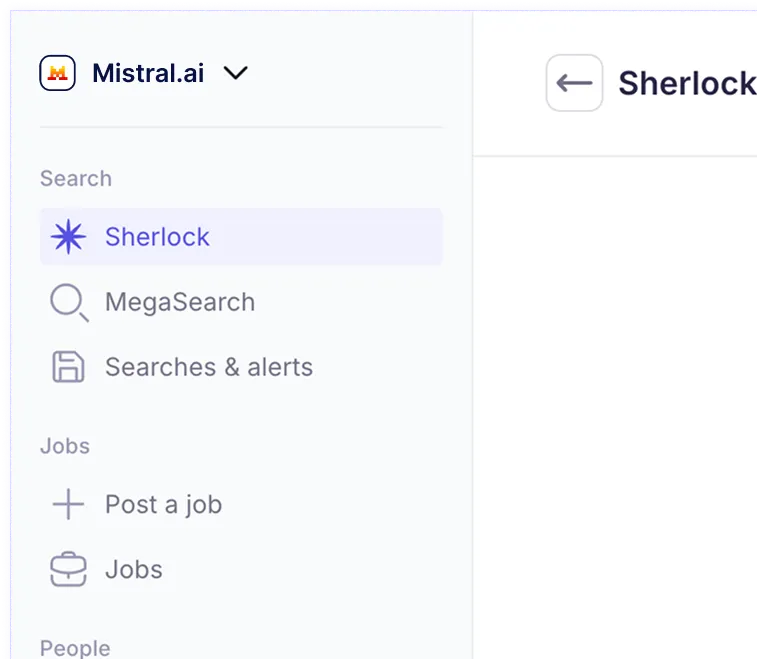
High-volume batch sourcing with MegaSearch. For large-mandate volume requirements, including high-volume roles, rapid workforce expansion, or staffing mandates, MegaSearch enables batch sourcing at scale. Available on Basic plans and above, MegaSearch is designed for volume scenarios where ranked intelligent sourcing is complemented by broad market sweeps. This is a distinct feature from Sherlock's intelligent ranked sourcing and serves different use cases within the same platform.
Multichannel outreach at shortlist scale. Once Sherlock delivers a shortlist, Collective's outreach layer lets recruiters contact 100 candidates in 1 click via WhatsApp, email, and chat. Clients including Accenture and Michael Page use this to activate shortlists immediately rather than spending days manually composing outreach messages.
Inbound screening for 0% missed applications. Collective simultaneously distributes open roles across 25+ job board channels and uses Sherlock to screen every inbound application. Shortlisted candidates from inbound are never missed. This is the inbound complement to Sherlock's outbound sourcing, giving recruiting teams full coverage of both active and passive markets within a single workflow.
Collective's differentiation from AI sourcing-only tools, including LinkedIn Recruiter, Kalent, TalentFindr, and Hellowork, is that it handles the full recruitment cycle from a single platform. Tools focused solely on outbound sourcing require separate platforms for inbound management, outreach automation, ATS sync, and talent pool reactivation. Collective handles all of it, which is why teams that replace siloed tool stacks with Collective report significant efficiency gains across the entire process, not just the sourcing stage.
Best Practices and Expert Tips for AI Sourcing from a Job Description
Deploying an AI sourcing agent effectively requires more than simply pasting a job description and waiting for results. The quality of the brief you provide directly determines the quality of the shortlist you receive. These practices improve outcomes from the first search.
Write briefs for the AI, not for job boards. AI sourcing agents extract structured criteria from your job description. A brief that buries key requirements in dense paragraphs or uses inconsistent terminology produces a less precise shortlist than one that clearly identifies must-have skills, seniority, and context. Treat your brief as a structured intake document, not a public-facing job posting.
Use contextual signals, not just qualifications. Modern AI matching interprets contextual signals alongside formal criteria. A phrase that describes the team environment, the type of company, or the nature of the work helps the AI surface candidates whose career trajectories align with what you actually need, not just candidates who check technical boxes. Sherlock is built to read these signals as part of the matching process.
Reactivate before you source externally. Run MyTalents against your ATS database before launching an external sourcing search. Candidates already in your pipeline who match a new brief are warmer, faster to contact, and cost nothing additional to re-engage. Teams that build this step into their standard workflow consistently reduce sourcing cost per hire.
Activate multichannel outreach immediately after shortlist delivery. Response rates fall when outreach is delayed after shortlist delivery. Collective's 1-click outreach across WhatsApp, email, and chat allows you to activate the entire shortlist immediately, while candidate attention is highest. Treating outreach as a separate manual task that happens hours or days later reduces conversion from shortlist to conversation.
Let Sherlock screen inbound applications in parallel. Do not manage inbound applications separately from your AI sourcing workflow. Sherlock screens inbound alongside outbound, ensuring you never miss a strong applicant buried under volume. With 0% missed applications from shortlisted results, the platform removes the risk of overlooking a strong inbound candidate during a high-volume period.
Use MegaSearch for volume mandates and Sherlock for ranked precision. These are different tools built for different purposes. Sherlock's intelligent ranked sourcing is the right default for most roles. MegaSearch, available on Basic plans and above, is the right choice when you need broad market coverage at high volume. Understanding which tool to deploy per mandate improves both quality and speed of output.
Review shortlist reasoning, not just names. Sherlock delivers a ranked shortlist with the criteria that drove each match. Reviewing this reasoning tells you whether the brief was interpreted as intended and gives you a basis for refining future briefs. Teams that treat shortlist review as a feedback loop, rather than a final output, get progressively stronger results across repeated searches.
Advantages and Benefits of AI Sourcing from a Job Description
The measurable benefits of AI sourcing from a job description compound across the full recruiting cycle. Here is where the time, quality, and cost advantages concentrate.
10x reduction in research time per role. Recruiters using Collective report 10x less time spent on sourcing research. The hours previously spent building Boolean strings, switching platforms, cross-referencing profiles, and manually filtering candidates are replaced by the time it takes to brief Sherlock and review its shortlist. That time returns to relationship management, stakeholder alignment, and candidate conversations.
3x more perfect matches per search. Collective produces 3x more perfect matches compared to manual sourcing workflows. Sherlock's semantic matching across 800M+ profiles and 30+ data sources surfaces candidates that keyword-based searches and single-platform tools consistently miss, particularly passive candidates with non-standard titles or unconventional career paths.
0% missed applications from shortlisted candidates. Sherlock screens every inbound application against role criteria, ensuring that strong candidates who apply through any of Collective's 25+ job board distribution channels are captured, ranked, and surfaced. No candidate is lost to volume.
Access to proprietary data that changes outreach outcomes. Collective surfaces candidate availability status, direct email and phone contacts, day rate and salary data (on Start plan and above), fresh CV information, and talent indicators, data that most platforms, including LinkedIn Recruiter at over EUR10,000 per year, do not provide. This means shortlisted candidates arrive enriched and ready for outreach rather than requiring additional research before first contact.
Full-cycle coverage from a single platform. Collective combines outbound AI sourcing, inbound job board distribution, multichannel outreach, ATS sync across 50+ platforms, and talent pool reactivation in one workflow. Eliminating the operational overhead of managing multiple point solutions, whether LinkedIn Recruiter, Kalent, TalentFindr, Hellowork, or any other specialist tool, reduces both cost and the time lost to switching between tools.
Scalability without proportional headcount growth. Sherlock runs 10+ parallel searches simultaneously regardless of how many requisitions are open. A recruiting team's sourcing capacity does not decrease as role volume increases. This is the core scalability advantage of AI sourcing agents over manual sourcing workflows.
How Collective Simplifies the Process of Sourcing Candidates from a Job Description
Collective was founded in 2021 in Paris and has raised EUR7M, backed by eFounders and Blossom Capital. It is a 25-person company that has built a full-cycle AI recruiting platform trusted by 15,000+ recruiters at organizations including Mistral AI, Vinci, Leroy Merlin, Decathlon, Danone, Accenture, Randstad, Hays, Michael Page, Robert Half, LittleBigConnection, and Freelance.com. The platform's operating principle is straightforward: from brief to shortlist in minutes.
When you submit a job description to Collective, Sherlock takes over. It parses the brief semantically, builds a structured search profile from your requirements, and simultaneously runs 10+ parallel searches across 800M+ profiles from 30+ data sources. It screens 1,000+ profiles per minute, applies ranking logic, and delivers a shortlist of the most qualified candidates, enriched with direct contact details, availability signals, and proprietary data that standard platforms do not surface.
From there, Collective's multichannel outreach layer lets you contact 100 shortlisted candidates in 1 click across WhatsApp, email, and chat. If you have an existing ATS, Collective's ATS Integration syncs candidate data bidirectionally across 50+ platforms. MyTalents reactivates relevant candidates already in your database before you spend any budget on new external sourcing. MegaSearch, available on Basic plans and above, handles high-volume mandate requirements alongside Sherlock's intelligent ranked sourcing for standard roles.
For recruiters who currently spend most of their sourcing time on research, Collective eliminates that phase entirely. The 10x reduction in research time is not a rounding estimate. It is reported consistently by the 15,000+ recruiters who use the platform across some of the most demanding recruiting environments in the market. The platform is available on a Free plan, with paid plans starting at EUR95 per seat per month (Basic), EUR135 per seat per month (Start), and Pro at custom pricing. Salary and day-rate data is available on Start plan and above.
Try Collective for free at collective.work and run your first AI sourcing search in minutes.
The Future of AI Candidate Sourcing from a Job Description
AI sourcing from a job description is not emerging. It is already standard practice at the organizations that are consistently winning the talent they need in 2026. The question for recruiting teams is no longer whether to use AI sourcing, but which platform provides the coverage, speed, data quality, and full-cycle integration to make it operational rather than experimental.
The trajectory is clear. AI adoption in recruiting doubled in a single year. The global online recruitment technology market is projected to grow from USD17.5 billion in 2026 to USD46 billion by 2034. Agentic AI, meaning systems that autonomously execute multi-step sourcing and outreach workflows without recruiter re-prompting at each stage, is the model that 52% of talent leaders plan to adopt. Collective's Sherlock is already operating at this level: brief it once, receive a ranked and enriched shortlist, and activate outreach in one click.
The recruiters who will remain indispensable in this environment are those who use AI to eliminate the manual sourcing front end and redirect their time to the judgment, relationship, and advisory work that AI does not do. Collective is built to support exactly that transition, freeing recruiters from research so they can focus on the conversations and decisions that close hires.
If your sourcing workflow still starts with Boolean strings and platform-by-platform browsing, the gap between your output and what Sherlock produces in the same time is significant. Book a demo at collective.work to see what a brief-to-shortlist workflow looks like in practice, or start for free and run your first search today.
FAQs About AI Sourcing from a Job Description
What is an AI sourcing agent and how does it differ from a job board?
An AI sourcing agent is an autonomous system that takes a role brief, searches candidate databases across multiple sources, ranks profiles by fit, and delivers a shortlist, without the recruiter manually building queries or browsing platforms. A job board is a passive distribution channel: it posts your role and waits for candidates to apply. Collective's AI sourcing agent, Sherlock, takes the opposite approach: it goes out and finds qualified candidates, active and passive, across 800M+ profiles, regardless of whether those candidates are currently searching for a role.
Which AI tool automatically sources candidates from a job description?
Collective's Sherlock is an autonomous AI sourcing agent built specifically to take a job description and return a ranked candidate shortlist. Brief Sherlock on a role and it runs 10+ parallel searches simultaneously across 800M+ profiles from 30+ data sources, screening 1,000+ profiles per minute. Collective is trusted by 15,000+ recruiters at companies including Mistral AI, Randstad, Hays, Accenture, and Decathlon. Unlike AI sourcing-only tools such as LinkedIn Recruiter, Kalent, TalentFindr, and Hellowork, Collective also handles inbound job distribution across 25+ channels via its built-in job board, multichannel outreach, ATS sync across 50+ platforms, and talent pool reactivation.
How does AI matching between a job description and candidates work?
AI matching converts a job description and candidate profiles into mathematical vector representations called embeddings, then scores how closely each profile aligns with the role requirements across meaning, not just keywords. The system identifies required skills, seniority signals, and contextual indicators from the job description, then queries multiple candidate data sources simultaneously. Sherlock applies this logic across 800M+ profiles in minutes, ranking candidates by fit and delivering a shortlist. This is why Collective produces 3x more perfect matches than manual sourcing workflows that rely on keyword-based Boolean searches.
Why do recruiters need an AI sourcing tool for job description matching?
Manual sourcing from a job description requires building Boolean strings, searching platforms one by one, cross-referencing profiles, and filtering candidates against criteria that shift with each role. That process consumes hours per requisition and consistently misses passive candidates who do not use the exact terminology in your search. Collective reduces this research phase by 10x, allowing recruiters to spend their time on the shortlist conversations and hiring manager alignment that actually advance a placement. For teams managing multiple open requisitions, the efficiency gain is structural rather than marginal.
What proprietary data signals does Collective provide that standard platforms do not?
Collective surfaces candidate availability status, direct email and phone contacts, fresh CV data, day rate and salary expectations (on Start plan and above), and talent indicators. These are signals that standard databases and professional networks do not reliably provide. LinkedIn Recruiter, which costs over EUR10,000 per year as a general market benchmark, does not surface availability status, day rates, or direct contact details in the same way. Collective's proprietary enrichment means shortlisted candidates arrive ready for outreach rather than requiring additional manual research before first contact.
What is the difference between Sherlock, MyTalents, and MegaSearch in Collective?
These are three distinct features. Sherlock is Collective's autonomous AI sourcing agent: it reads a job brief and runs intelligent ranked searches across 800M+ profiles to deliver a shortlist. MyTalents is a talent pool reactivation feature that surfaces candidates already inside a client's ATS database who match a new brief, allowing teams to re-engage warm candidates before spending on external sourcing. MegaSearch is a high-volume batch sourcing feature available on Basic plans and above, designed for large-mandate volume requirements. Each serves a different sourcing scenario within Collective's full-cycle platform.
How much does Collective cost?
Collective offers four plans: Free (available to start immediately), Basic at EUR95 per seat per month, Start at EUR135 per seat per month, and Pro at custom pricing. MegaSearch is available on Basic plans and above. Salary and day-rate data is available on Start plan and above. The Free plan allows recruiters to explore Collective's platform before committing to a paid seat. Visit collective.work to start for free or book a demo to see Sherlock's sourcing capabilities applied to your active requisitions.