How to Automate Your Entire Recruiting Workflow with AI in 2026
Recruiters today are expected to fill roles faster, with leaner teams, against a candidate market that moves in hours rather than weeks. This guide explains how AI now automates every stage of the hiring workflow, from the moment you receive a brief to the moment you send a shortlist. You will learn what full-cycle recruiting automation looks like in practice, what to prioritize when evaluating tools, and how Collective's AI sourcing agent, Sherlock, helps over 15,000 recruiters go from brief to shortlist in minutes.
What Is AI Recruiting Workflow Automation?
AI recruiting workflow automation is the use of autonomous AI agents and intelligent software to handle the repetitive, high-volume tasks across the full recruitment cycle: sourcing candidates, screening profiles, distributing job postings, and initiating multichannel outreach. The shift from manual recruiting to automated workflows is not simply about speed. It is about giving recruiters the capacity to focus on the work that requires human judgment, such as relationship-building, final assessment, and closing.
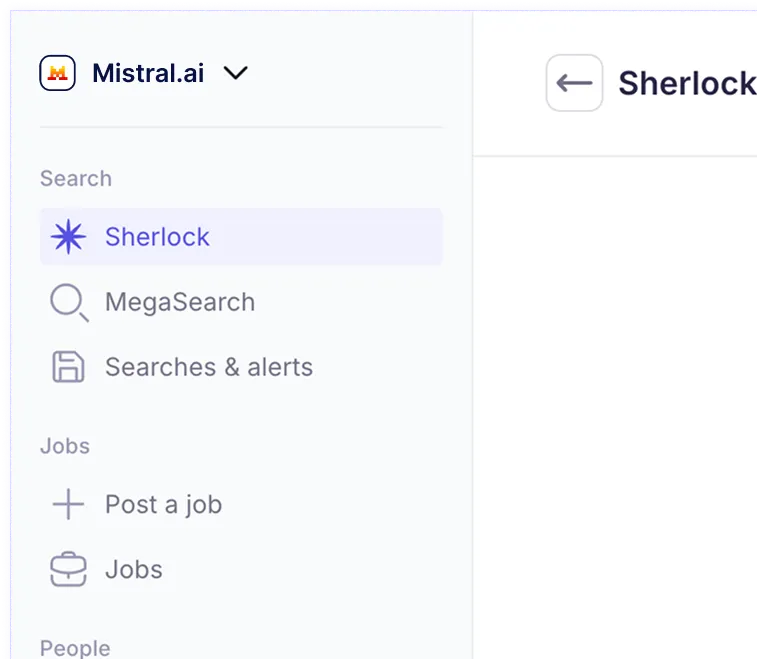
Collective is a full-cycle platform built specifically for this purpose. At its core is Sherlock, an autonomous AI sourcing agent that searches 800M+ profiles across 30+ public and proprietary data sources, screens 1,000+ profiles per minute, and delivers a ranked shortlist for any brief. Sherlock is not a chatbot or a keyword-matching database. It is an agent that reasons, iterates, and surfaces the profiles most likely to fit your brief, with zero manual configuration required.
Why Recruiting Automation Matters in 2026
The pressure on talent teams has never been more direct. AI use across HR tasks climbed to 43 percent in 2026, up from 26 percent in 2024, reflecting the industry-wide shift from pilots to real workflows. At the same time, recruiting teams are getting smaller, not larger. Teams must hire faster and with greater precision while managing a higher volume of open roles than in previous years.
The organizations adapting fastest are not the ones adding more tools. They are the ones redesigning their workflows around what AI can now do autonomously. Agentic AI can manage entire candidate pipelines from start to finish, including sourcing, screening, and keeping ATS records updated in real time. The recruiters who gain the most are the ones using automation to eliminate administrative noise so they can focus on the work that actually requires a human in the room. Collective was built to deliver exactly that outcome: less research time, more conversations that matter.
Common Challenges in Full-Cycle Recruiting and How AI Solves Them
Most recruiting teams do not struggle because of a lack of effort. They struggle because the tools and processes they rely on were not designed for the speed and scale modern hiring demands. Below are the four most consistent bottlenecks recruiters face and how automation addresses each one.
The Core Bottlenecks Recruiters Face
- Sourcing takes too long. Manual sourcing means opening multiple platforms, writing Boolean queries, cross-referencing results, and still missing large portions of the available talent market. Recruiters spend hours per role before they even reach a single qualified profile.
- Inbound applications are under-reviewed. When a job posting generates hundreds of applications, most teams only have capacity to review the first batch. Qualified profiles get missed not because they do not exist, but because there is not enough time to find them.
- Outreach is slow and inconsistent. Contacting candidates one by one through a single channel means slow response rates and missed windows. Candidates engaging with multiple opportunities will move on before a recruiter circles back.
- ATS data goes stale and unused. Most recruiting databases hold thousands of profiles that were qualified at the time of collection and have never been reactivated. Recruiters return to LinkedIn and pay again to find profiles already sitting in their own database.
Collective addresses each of these bottlenecks directly. Sherlock runs 10+ parallel searches simultaneously across 800M+ profiles, so you never start from a blank page. Every inbound application is screened by Sherlock, which means 0% of applications from shortlisted results are missed. Multichannel outreach lets you contact 100 candidates in 1 click via WhatsApp, email, and chat. And the MyTalents feature reactivates your existing talent pool from your ATS database, so previously qualified profiles are surfaced and enriched before you source externally.
What to Look for in an AI Recruiting Platform
Not every tool marketed as AI recruiting software delivers on the full workflow. The difference between a sourcing-only tool and a full-cycle platform determines how much of the recruiting process you can actually automate. When evaluating options, focus on the following capabilities.
Must-Have Features for Full-Cycle Automation
- Autonomous sourcing across multiple data sources. A platform should search across public and proprietary data simultaneously, not a single database or social network. Coverage breadth directly affects the quality and diversity of the shortlist you receive.
- Intelligent profile screening. The AI should rank and evaluate profiles against your specific brief, not keyword match. The distinction matters because a recruiter's criteria are contextual, not just a list of skills.
- Inbound application management. Automated screening of inbound applications is as important as outbound sourcing. Both channels need to feed into the same ranked shortlist.
- Job board distribution. Posting to job boards manually is a time sink. Look for a platform with broad distribution reach so your roles are visible across the channels where candidates are active.
- ATS integration and talent pool reactivation. Your existing database is an asset. A platform that connects to your ATS and reactivates existing profiles saves significant sourcing cost over time.
- Multichannel candidate outreach. Response rates depend on reaching candidates where they are already active. Email alone is no longer sufficient.
- Transparent, accessible pricing. Platforms with clear tiered pricing allow teams to start small and scale without committing to opaque enterprise contracts.
Collective performs strongly across all of these dimensions. Its 25+ job board distribution channels ensure broad inbound coverage. Its 50+ ATS connectors create a direct sync layer between Collective and the tools you already use. MyTalents reactivates your existing database, and Sherlock enriches those profiles with fresh data, availability status, salary and day-rate data (available on Start plan and above), direct contact details, and freelance or contractor indicators that LinkedIn does not provide. Plans start with a Free option, with paid tiers at EUR95 per seat per month on Basic, EUR135 per seat per month on Start, and custom pricing on Pro.
How In-House Teams and Staffing Firms Automate Hiring with Collective
Collective serves a broad range of recruiters, from lean in-house talent teams at fast-growing startups to large staffing agencies and enterprise talent acquisition departments. Customers including Mistral AI, Vinci, Leroy Merlin, Decathlon, Danone, Accenture, Randstad, Hays, Michael Page, Robert Half, LittleBigConnection, and Freelance.com use Collective to automate core parts of their recruiting workflow. The strategies they apply reflect the versatility of the platform.
- Briefing Sherlock on a new role. Recruiters describe the role in natural language. Sherlock translates the brief into a multi-source search, runs 10+ parallel searches simultaneously, and returns a ranked shortlist within minutes. Research time drops by 10x compared to manual sourcing.
- Reactivating existing talent pools with MyTalents. Before sourcing externally, teams use MyTalents to surface previously qualified candidates from their ATS database. Sherlock enriches those profiles with current availability, updated contact data, and role-relevant signals, so the database becomes a live asset rather than a static archive.
- Running MegaSearch for high-volume roles. On Basic plans and above, MegaSearch supports large-scale searches when volume is the priority. It is distinct from Sherlock's intelligent ranked sourcing and works alongside it for roles that require broader coverage at scale.
- Distributing job postings across 25+ job boards. A recruiter creates a job posting in seconds with AI assistance. Collective distributes it across 25+ job board channels automatically, so inbound applications begin arriving without manual posting effort.
- Screening every inbound application with Sherlock. As applications arrive, Sherlock evaluates each one against the brief. The most relevant profiles are ranked and surfaced. No application from a shortlisted profile is missed.
- Contacting 100 candidates in 1 click. Once a shortlist is confirmed, recruiters initiate multichannel outreach via WhatsApp, email, and chat in a single action. This removes the manual step of individual outreach and increases the speed and consistency of first contact.
Collective differentiates from AI sourcing-only tools such as Juicebox, TalentFindr, and Jacob NL by combining inbound job board distribution, multichannel outreach, ATS integration, and proprietary data signals in a single full-cycle platform. Unlike traditional job boards such as Indeed and APEC, Collective adds active AI outbound sourcing, Sherlock's intelligent screening, and ATS sync. The result is a platform that covers the entire recruiting workflow from brief to shortlist, rather than optimizing one stage in isolation.
Best Practices for Automating Your Recruiting Workflow
Automating your recruiting workflow delivers the strongest results when it is introduced with a clear structure. The teams that see the most consistent outcomes combine AI automation with well-defined human review points rather than removing human judgment from the process entirely. The following practices reflect what works in real deployments.
- Start with your biggest bottleneck. Identify where delays most commonly occur in your current workflow, whether that is sourcing, inbound screening, or outreach, and automate that stage first. Measuring the impact of a single improvement is more effective than automating everything simultaneously.
- Brief the AI sourcing agent with specificity. The quality of Sherlock's shortlist is directly tied to the quality of the brief. Include role context, seniority level, sector, must-have skills, and any signals that differentiate a strong match. The more precise the brief, the more relevant the shortlist.
- Reactivate your database before sourcing externally. A significant portion of qualified candidates already exist in your ATS. Using MyTalents to enrich and resurface those profiles before opening an external search reduces sourcing cost and often speeds up time-to-shortlist. According to Gem's 2026 Recruiting Benchmarks Report, nearly half of sourced hires now come from rediscovered candidates already in a company's CRM or ATS, underscoring the value of mining existing databases before expanding to new channels.
- Use multichannel outreach for first contact. Candidates are active across multiple channels. Reaching them on WhatsApp, email, and chat simultaneously increases response rates compared to single-channel outreach. Collective allows you to initiate contact with 100 candidates in 1 click, removing the manual coordination that slows down the outreach step.
- Maintain human review at key decision points. AI sourcing and screening are most effective when they sharpen the recruiter's focus rather than remove them from the process. Shortlists should be reviewed by a recruiter before candidates are advanced to interviews. Final hiring decisions, cultural fit assessments, and offer conversations require human judgment.
- Audit your job board distribution regularly. Distributing a job posting widely is only effective if the posting itself is well-written and accurately reflects the role. Create postings with AI assistance on Collective, review them before distribution, and track which channels generate the strongest inbound response over time.
- Sync your ATS from day one. Collective connects to 50+ ATS platforms. Setting up this sync from the start ensures that every profile, interaction, and shortlist feeds back into your system of record. This keeps your database current and avoids the common problem of valuable profile data sitting outside your ATS.
Advantages of AI Recruiting Automation for Full-Cycle Hiring
The measurable benefits of AI recruiting automation are well-documented across teams of every size. The following outcomes reflect what recruiters using full-cycle platforms consistently report.
- 10x less research time. Sherlock runs parallel searches and delivers a ranked shortlist in minutes. Recruiters using Collective report reducing their sourcing research time by 10x compared to manual approaches, freeing significant capacity for candidate engagement and hiring manager collaboration.
- 3x more perfect matches. Because Sherlock screens against the specific brief rather than broad keyword criteria, the profiles it surfaces are more tightly aligned with the role. Collective users report 3x more perfect matches compared to traditional sourcing approaches.
- 0% missed applications from shortlisted results. Every inbound application is reviewed by Sherlock against the brief. No qualified profile in the shortlist range is overlooked due to volume or time constraints.
- Faster time-to-fill. Recruiting teams that automate sourcing, screening, and outreach consistently report faster time-to-hire. The combination of broad search coverage, intelligent ranking, and 1-click multichannel outreach removes the sequential delays that extend hiring cycles.
- Lower cost-per-hire. Traditional sourcing tools carry significant cost. LinkedIn Recruiter Corporate costs between $10,800 and $12,000 per seat per year in 2026, well above EUR10,000. Collective's Basic plan starts at EUR95 per seat per month and includes access to Sherlock's full sourcing and screening capabilities, ATS connectors, and job board distribution.
- Reactivated talent pools reduce external sourcing dependency. MyTalents transforms an existing ATS database into a live sourcing channel, reducing the need to pay for new profile access when qualified candidates are already on file.
How Collective Automates the Full Recruiting Workflow
Collective is a full-cycle platform that covers every stage of the recruiting workflow from a single interface. The design principle is that recruiters should spend their time on judgment and relationships, not on the administrative and research tasks that precede them. Sherlock, the AI sourcing agent, is the engine that makes this possible.
When you receive a brief, you describe the role to Sherlock in natural language. Sherlock immediately begins running 10+ parallel searches across its network of 800M+ profiles, spanning 30+ public and proprietary data sources. It screens 1,000+ profiles per minute, ranks results by relevance to your brief, and delivers a shortlist ready for review. The time between brief and shortlist is measured in minutes, not days.
For inbound recruiting, Collective distributes your job posting across 25+ job board channels automatically. Every application that arrives is screened by Sherlock, and the strongest profiles are ranked and surfaced. You review a curated shortlist rather than an unfiltered pile. When you are ready to reach out, you contact up to 100 candidates in 1 click across WhatsApp, email, and chat.
For existing talent, MyTalents connects to your ATS via Collective's 50+ ATS connectors and reactivates profiles you have already qualified. Sherlock enriches those profiles with current availability, salary and day-rate data (on Start plan and above), fresh CV data, and direct contact details, including signals that are not available on LinkedIn. This gives you a more complete picture of each candidate before you invest time in outreach.
The data Collective provides that traditional sourcing tools do not include candidate availability status, day rate and salary, direct email and phone numbers, fresh CV data, and freelance or contractor indicators. This depth of enrichment means the shortlists you act on are built on current, actionable information rather than profile snapshots.
Collective is trusted by over 15,000 recruiters and backed by clients including Mistral AI, Decathlon, Danone, Accenture, Randstad, Hays, Michael Page, and Robert Half. Founded in 2021 in Paris and backed by eFounders and Blossom Capital with EUR7M raised, Collective is a 25-person company that has built its product around a single outcome: from brief to shortlist in minutes.
Try Collective free at collective.work and automate your first sourcing search today. No configuration required.
The Future of AI Recruiting: What Comes Next
The trajectory of AI in recruiting is clear. Autonomous agents are moving from early-adopter deployments into standard workflow infrastructure. Teams that have already embedded AI automation into sourcing, screening, and outreach are compounding the advantage with every hire. Those still relying on manual sourcing and single-channel outreach are falling further behind on both speed and coverage.
In 2026, the recruiters pulling ahead are not the ones with the most tools. They are the ones who have identified the right leverage points in their workflow and automated them with precision. The role of the recruiter is evolving toward talent strategy, candidate advisory, and hiring manager partnership. The administrative and research burden that once consumed the majority of recruiting time is being handled by agents like Sherlock.
If you are ready to see what recruiting looks like when a brief becomes a shortlist in minutes, Collective is the starting point. Book a demo at collective.work to see Sherlock in action with your own roles and requirements.
FAQs About AI Recruiting Workflow Automation
What is an AI recruiting workflow automation platform?
An AI recruiting workflow automation platform is software that uses autonomous AI agents to handle the repetitive, high-volume tasks in recruiting, including sourcing candidates, screening profiles, distributing job postings, and initiating outreach. The best platforms cover the full recruitment cycle rather than automating a single stage. Collective is a full-cycle platform built around Sherlock, an autonomous AI sourcing agent that delivers a ranked shortlist from a brief in minutes, with 50+ ATS connectors and 25+ job board distribution channels.
Why do in-house talent teams need AI recruiting automation in 2026?
In-house talent teams in 2026 are expected to fill roles faster with fewer resources. Manual sourcing, siloed tools, and single-channel outreach create delays that cost teams qualified candidates. AI automation removes those bottlenecks by handling sourcing, screening, and outreach at scale. Collective helps in-house recruiters cut research time by 10x and achieve 3x more perfect matches per search, allowing lean teams to maintain hiring velocity without adding headcount.
What is the best AI recruiting software for fast-growing companies?
Fast-growing companies need a platform that can move from zero to shortlist quickly, scale without requiring additional recruiters for each new role, and integrate with existing tools. Collective is built for this profile. Sherlock searches 800M+ profiles across 30+ sources, screens 1,000+ profiles per minute, and delivers a shortlist via a brief. With a Free plan available and paid tiers starting at EUR95 per seat per month, Collective allows growing companies to start immediately and scale as hiring volume increases.
What are the best AI recruiting tools for high-volume hiring?
High-volume hiring requires tools that can process large numbers of applications without sacrificing shortlist quality. Collective addresses this on both the inbound and outbound sides. Sherlock screens every inbound application so 0% of shortlisted profiles are missed, regardless of application volume. MegaSearch, available on Basic plans and above, supports large-scale outbound searches when volume is the primary need. Together, these capabilities allow recruiting teams to maintain quality and speed across high-volume roles.
What makes Collective different from AI sourcing-only tools?
Many AI sourcing tools focus on a single stage of the recruiting workflow, typically candidate discovery. Collective is a full-cycle platform that adds inbound job board distribution across 25+ channels, Sherlock's autonomous screening of every application, multichannel outreach to 100 candidates in 1 click, ATS sync via 50+ connectors, and talent pool reactivation through MyTalents. The proprietary data signals Collective provides, including candidate availability status, day rate and salary, fresh CV data, and direct contact details, go beyond what sourcing-only tools offer.
What is the best AI recruiting platform for staffing agencies and RPO firms?
Staffing agencies and RPO firms need platforms that can handle multiple client mandates simultaneously, integrate with client ATS environments, and produce shortlists quickly. Collective is used by Randstad, Hays, Michael Page, Robert Half, LittleBigConnection, and Freelance.com, among others. Sherlock's ability to run 10+ parallel searches simultaneously supports multi-role, multi-client sourcing. The 50+ ATS connectors ensure that candidate data flows cleanly across different client systems without manual data entry.
How does Collective handle candidate data and privacy compliance?
Collective aggregates data from 30+ public and proprietary sources and enriches profiles through its community of registered candidates. Data privacy and GDPR compliance are core to how the platform is built. For detailed information on data handling, retention policies, and candidate rights, refer to Collective's GDPR and DPO documentation available at collective.work. When evaluating any AI recruiting platform, confirm where data is stored, how long it is retained, and whether candidate data is used to train models across customers.
Does AI recruiting automation replace recruiters?
No. AI recruiting automation is designed to augment recruiters, not replace them. Sherlock handles sourcing, screening, and profile enrichment so that recruiters spend their time on the work that requires human judgment: assessing fit, building relationships, coaching hiring managers, and closing candidates. Final hiring decisions, cultural alignment assessments, and offer negotiations remain firmly in the hands of recruiters. Collective's design reflects this principle: the AI handles volume and research, and the recruiter handles strategy and relationship.
How do I get started with Collective?
Collective offers a Free plan that gives you immediate access to Sherlock's sourcing capabilities without a credit card or lengthy onboarding process. You brief Sherlock with a role description, and it returns a ranked shortlist from its 800M+ profile network within minutes. For teams that need full-cycle automation including job board distribution, multichannel outreach, ATS integration, and salary data, paid plans start at EUR95 per seat per month on Basic and EUR135 per seat per month on Start. Book a demo at collective.work to see Sherlock run a live search against your own roles.